
My Award-Winning Essay: Nowhere
The Spiritual Exile of an Adoptee in Korea
This essay was the winner of the 2019 Construction Literary Magazine Non-Fiction Prize.
Flying Asiana Airlines for my 19-hour trip in the sky, I was immediately struck by its signature commodity: The gorgeous attendants, replete with winning smiles, trim waist-lines, and windswept hair already in flight. Languishing behind them in line at customs, I marveled at these Asian sirens chatting with our dashing stewards, their slim silhouettes carving out a carefree commercial of beautiful mommies and handsome daddies any abandoned Korean child would want. They made me want to be Korean.
Finally at the counter, my passport was stamped: August 18, 2017. Exactly 36 years after my birthmother surrendered me to the orphanage — to the day. It was also my white, adoptive mother’s birthday. The earliest photograph of me was at six months old, wrapped in a caul of confusion. Happy birthday, Mom.
Passing through a set of enormous double doors, I was greeted by a sea of Mongolian faces when I spotted someone who seemed to recognize my face, holding a sign with my name on it: Mee Ok. He took my suitcase and I stretched my legs before immediately being hurried through the airport at a dizzying speed. ATM — SIM card — Water — Bathroom. “Anything else before we leave here? Once we’re in Seoul it can get — complicated.”
“Jesus, I dunno.” I was still half asleep.
He smiled. “Well, I guess we’ll find out.”
My escort was Jes (pronounced ‘Yes’), who I called Jess for way too long because I never knew Denmark had so many Korean adoptees, and because I didn’t know Jes was a Danish name. Also, because his English was so pristine and I had never before met a non-American adoptee, I assumed it was some hippie spelling of Jess — after all, he had long hair and a matching Buddhist jacket and pants. A former participant turned volunteer for ‘First Trip Home’ — a sort of K-version of ‘Birthright Israel’ — his presence was a great introduction to the program. The leader, it turned out, was also a Dane, as were 3 of our 15 participants. It was only when I witnessed them stepping out of English into their native language that I realized how arbitrary and bizarre it was that I spoke English with a perfect American accent. Seeing Koreans speak Danish didn’t just feel multi-cultural — it sucked me into an alternate multi-verse, like I was suddenly transported to a sister planet where, at any moment, tall, Asian-looking Danes named Min-jun and Ji-woo could enter the scene speaking flawless Korean, bowing and greeting me, Annyeonghaseyo.
Together Jes and I rode the train from Incheon to the guesthouse in Seoul, situated in a trendy, touristy area with a high concentration of hostels and colleges, drunk people, street vendors, and late-night haunts. I was overwhelmed, not only from the overstimulation of this incredibly dense city, but also by how tired I was. I had been up for 24-hours straight. And now I was trying to coherently converse with my Korean Virgil as we crossed the River Han.
I don’t remember much of what was said, but I do remember that he didn’t look Korean to me, resembling instead a long-haired version of this Laotian kid from Arkansas I went to school with who was kind of a dick. I guess not all Koreans look Korean, I thought to myself, not knowing that the adopted Korean faces I would soon meet would look Nepalese, Taiwanese, Samoan — even Peruvian.
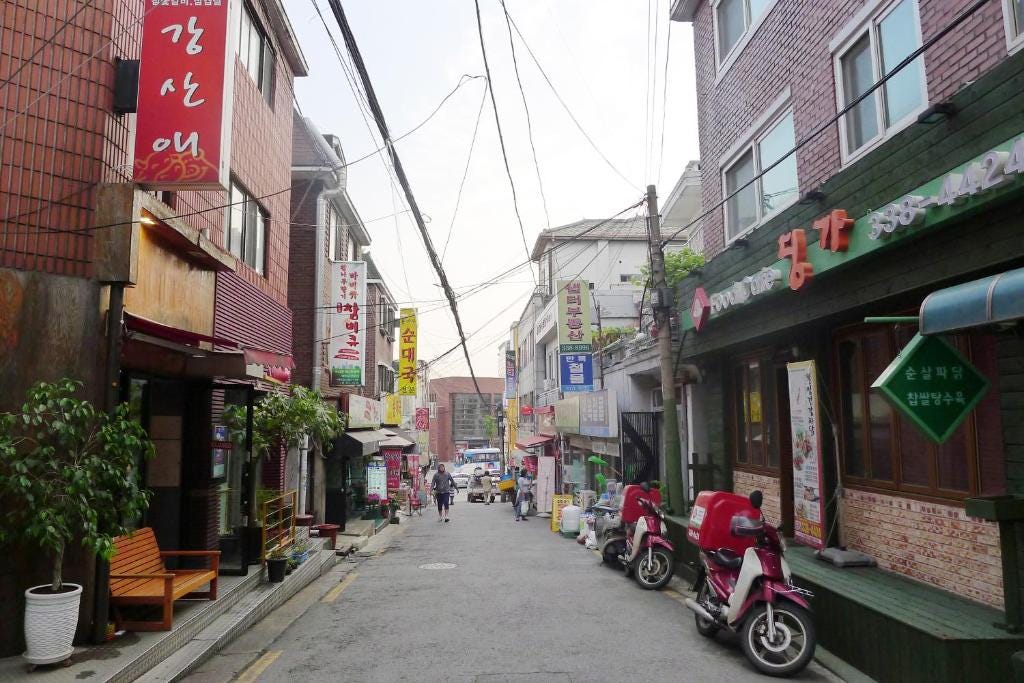
When we arrived at the travel house, the neon sign read “BoA,” and underneath its glow, a small, unassuming man stood statue-still as though he were trying not to attract predators — his quiet energy almost apologizing for being there despite the fact he was there to kindly deliver my key. He and Jes both saw me up to my room where I detonated my suitcase, its contents exploding like a carpet bomb all over the tiny room. As they patiently hovered by my door, knowing I would be lost without them, I collected my essentials before asking to be led to food.
Jes bid us farewell, leaving me with my new friend, whose name I couldn’t seem to remember, no matter how many times I asked. An adoptee in Boston had told me before my flight that she once visited a psychic astrologer who always knew clients were adopted when she couldn’t sense their birthdays. In a way, all adoptees are given a new beginning, an arrival day, but many of us — perhaps most — are actually given new birthdays entirely, inventions of our orphanages because our true birthday is unknown, or because our real age made us less marketable and we could pass for younger.
There are seven adoptees, for example, currently living in the U.S., who share the name and birthday of the same Korean adoptee. We only know this because the original — if you will — found her birthmother who was able to confirm that she was indeed herself. In any case, my new friend, whose name I would eventually commit to memory as Barry, was found swaddled without comment by the police near a motel. His age and birthday are some nameless bureaucrat’s guess, and his Korean name is a fabrication of the system that manufactures said bureaucrats. I tell myself this is why I can’t remember his name, although I can’t ever seem to remember any adoptees’ names unless they go by their birth names. Or if they look like Asiana flight attendants.
Barry, seeing that I hadn’t eaten, wasn’t hungry, had no energy, but should definitely eat something, led me across the street where dishes were strewn out before us the moment we sat down. We spent little and ate well: Fish grilled to perfection, soups, sauces, pickled vegetables — my tongue instantly fluent in this culinary world.
Our conversation was like a dream. Then I went to bed.
I don’t remember sleeping, only waking up too early and not being able to fall back asleep. It was 7 a.m. — 6 p.m. Boston time — and so I decided to wander. Born without an internal GPS, I was immediately lost without a phone or internet connection and walked for hours with random Koreans on the street giggling at my map, seeing how far away I was from where I wanted to be. The streets of Hongdae were trashed with a few stumbling millennials crossing my path and nothing except 7-Elevens to offer me sustenance.
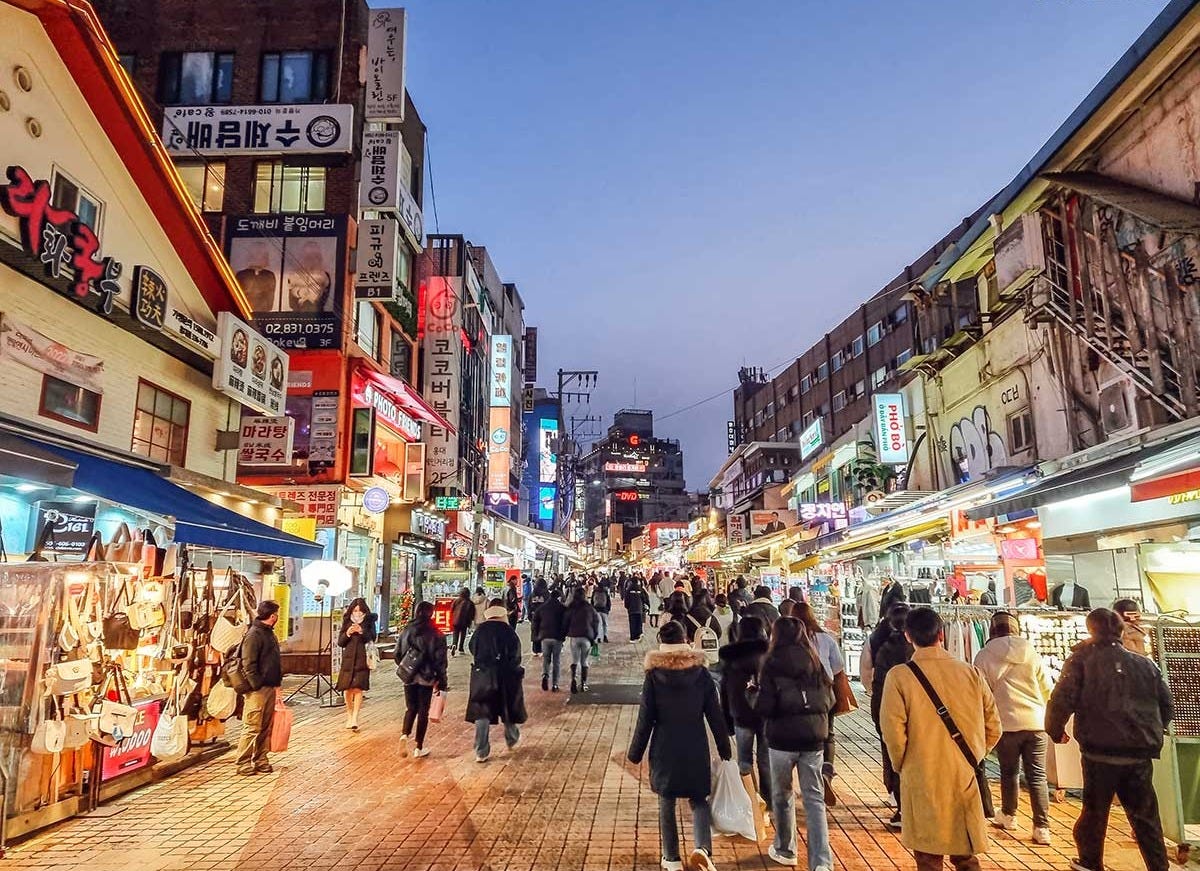
I was quickly realizing that I was in the college-dense part of town, somewhere between a dystopian state fair and a futuristic Vegas. If this was Seoul, I hated what had become of my homeland. Everywhere were pictures of male models holding beers, their pale faces with blood-red lips looking out at me like K-ghosts. Everywhere was sugar, coffee, alcohol, and gluttony mixed with the odd reminder that this was indeed a Christian nation — a neon cross still glowing night-red and nuns quietly shuffling down the godless streets. My feet hurt, I didn’t have any cash with me, and I didn’t even know the address of the guesthouse.
Finally, something that could only happen in Korea: I was happy to see a Starbucks. I rushed over to the entrance, and, like a waif huddling near its ambient warmth, I hovered against the glass in search of a wifi signal, hoping to catch some hi-tech breadcrumbs that would see me home.
When BoA popped up on my screen, it hit me: I was actually quite close. I had been walking around in concentric circles — a feeling at once lovely and idiotic.
So far Korea was a massive disappointment. Another adoptee’s voice whispered into my ear, When you step off the plane, it will feel like home. I had been skeptical of this, though a deep hollow within me, untapped since infancy, longed for it to be true. I hoped for a primal slumber to awaken within my mind and body, the kind I had read about. But standing in the most westernized of all the Far Eastern nations, I was instantly bombarded by the familiar world of romanized lettering, global corporatization, and an unmistakably occidental aesthetic. It was like being in a technologically advanced U.S. city populated exclusively by Korean people who started in the 1950s, skipped the 60s, 70s, and 80s, and went straight to living in the 90s. No allergies in restaurants. K-pop, with its saccharine echo of 90s slow jams and ballads, playing everywhere. Friends being all the rage. And streets filled with people all dressed conservatively, trying to embody whiteness more strongly than my lifelong desire to deny my Koreanness.
You’re going to be so pretty, like your mother, I could hear Mom say, as I stood on the empty streets, marveling at beer ads filled with powdered white Korean faces staring out at me from under surgically altered eyelids.
